Journal policies
About the journal
Submit a paper
Editorial policies
Access and rights
Fees and funding
Information
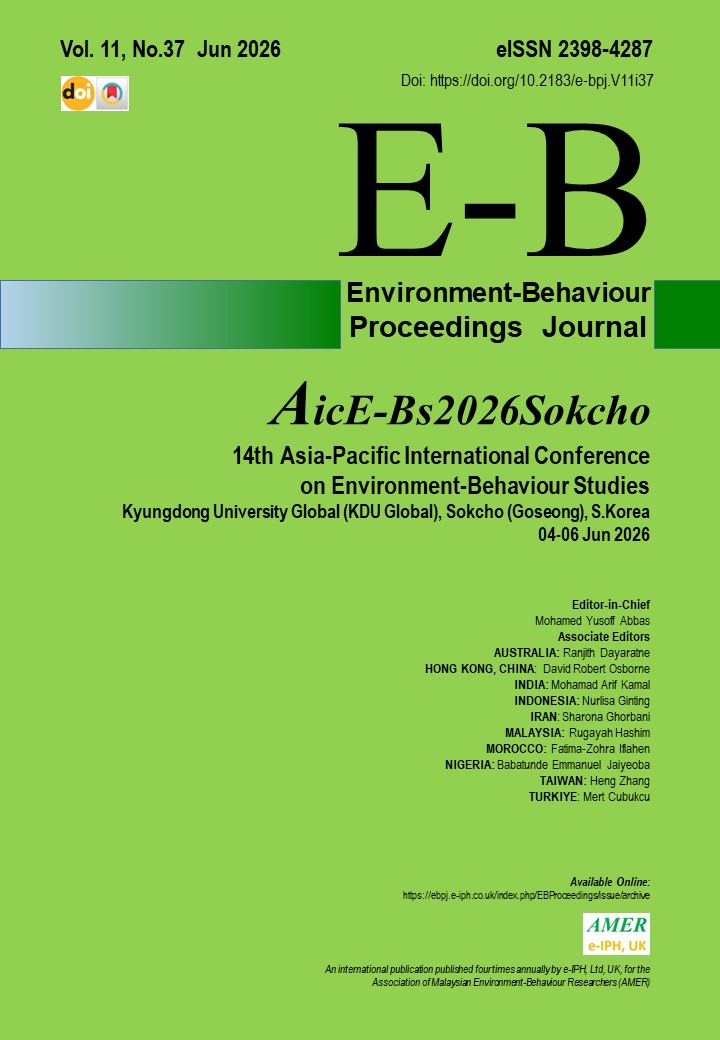
The hybrid 14th Asia-Pacific International Conference on Environment-Behaviour Studies (AicE-Bs2026Sokcho) marked AMER’s 54th international event, hosted by KDU Research Centre and IIUM's KSTCL from 4–6 June 2026.
Further information about the conference is available through the official AMER event page:
https://www.amerabra.org/index.php/aice-bs2026sokcho-04-06-jun-2026/
Of the 38 papers presented, 23 papers were subsequently selected and approved for publication in E-BPJ Volume 11, Number 37.
Editorial Architecture & Asia-Pacific Trans-Regional Focus
Environment-Behaviour Proceedings Journal (E-BPJ), Volume 11, Number 37, comprises 23 selected papers associated with AicE-Bs2026Sokcho. The volume extends the preceding Asia-focused orientation of Vol. 11 No. 36 by adopting a broader Asia-Pacific and trans-regional perspective, examining interactions between local environmental and behavioural conditions and wider regional, trans-regional and global influences.
The selected papers are organised around six principal thematic themes:
These themes establish the principal editorial scope of the volume, encompassing multidisciplinary Environment-Behaviour Studies research addressing technological, socio-economic, spatial, cultural, educational, health and environmental changes across interconnected Asia-Pacific contexts.
Editorial Scope & Quality Control
The editorial selection process maintained a defined Asia-Pacific and Environment-Behaviour Studies scope, with submissions outside the thematic or disciplinary scope excluded from E-BPJ Vol. 11 No. 37. Of the 38 papers presented, 23 manuscripts were selected and approved for publication following the conference's pre-conference manual double-blind peer-review process, administered through secure institutional email networks. The selected manuscripts subsequently underwent Turnitin similarity screening with a similarity index below 15%, prior to final publication on 18 June 2026.
Accordingly, Vol. 11 No. 37 is positioned as the Asia-Pacific extension of the preceding Asia-focused Vol. 11 No. 36, broadening the geographical and conceptual frame toward regional, trans-regional and interconnected Environment-Behaviour Studies.